Home  /  CHART Curriculum

The CHART curriculum

Clinical Health Advancement & Readiness Training — AcuityCare's proprietary four-level credentialing pathway for Direct Support Professionals serving people with intellectual and developmental disabilities under the Arkansas CES Waiver.

Level 1

AR-CDSP I — Arkansas Certified Direct Support Professional I

Days 1–10 · 14 modules · the foundation of all CES Waiver DSP training. Every new hire completes all 14 modules before any unsupervised consumer contact.

21.0 hrs
1.1
Program Orientation, CES Waiver & HCBS Settings
1.5 hrsLMS · self-pacedLMSW Director

DSPs learn the AcuityCare mission, the CES Waiver authority, the HCBS Settings Rule, the PASSE model, the NADSP Code of Ethics, and the four CHART credential levels — the operational floor of all future modules.

Topics covered
  • AcuityCare mission, values, and organizational structure
  • CES Waiver — 1915(c) authority and eligible IDD populations
  • HCBS Settings Rule (42 CFR §441.301) — community integration in daily practice
  • The Arkansas PASSE model — service authorization and payment
  • DSP professional boundaries and the NADSP Code of Ethics
  • CHART credential pathway from AR-CDSP I to AR-CNHS
1.2
HIPAA, Confidentiality & Records Protection
1.5 hrsLMS · self-pacedLMSW Director

Covers federal HIPAA, what counts as Protected Health Information, the minimum necessary rule, social media policy, and Arkansas state confidentiality laws beyond HIPAA.

Topics covered
  • HIPAA overview — covered entities and DSP obligations
  • PHI — verbal, written, and electronic forms
  • Minimum necessary rule and allowable disclosures in CES homes
  • Social media and digital privacy policy
  • Consumer privacy in shared living environments
  • Civil and criminal penalties for HIPAA violations
1.3
Mandated Reporter, Incident Reporting & AR Maltreatment Acts
1.5 hrsLMS · self-pacedLMSW Director

Arkansas Child and Adult Maltreatment Acts, mandated reporter obligations, the 18 reportable incident types under the 1915(c) Waiver, and AcuityCare's zero-retaliation policy.

Topics covered
  • AR Child Maltreatment Act (§12-18-101) and Adult Maltreatment Act (§12-12-1701)
  • Criminal penalties for failure to report (§12-18-201)
  • AR Child Abuse Hotline (1-800-482-5964) and Adult Protective Services
  • CES §702 incident reporting — 1-hour critical, 48-hour standard
  • §703 Legal guardian notification within 1 hour
  • Objective documentation language — what to write, what to avoid
1.4
Abuse, Neglect & Exploitation Prevention
1.5 hrsLMS · self-pacedLMSW Director

All forms of abuse, neglect, and exploitation in IDD care — warning signs, IDD-specific vulnerability factors, professional boundary violations, and AcuityCare's zero-tolerance policy.

Topics covered
  • Physical, emotional, sexual, and financial abuse
  • Active, passive, and systemic neglect in provider settings
  • Exploitation — financial, identity, and caregiver exploitation
  • IDD-specific vulnerability factors
  • Corporal punishment — strictly prohibited; immediate report required
  • Consumer-to-consumer abuse — recognition and reporting
1.5
Consumer Rights, Beneficiary Rights & IDD Foundations
1.5 hrsLMS · self-pacedLMSW Director

CES §601 beneficiary rights, the history of IDD services, the Olmstead Decision, person-first language, and the principle of dignity of risk in daily DSP practice.

Topics covered
  • CES §601 — beneficiary rights list with daily DSP application
  • ADA, Developmental Disabilities Act, Olmstead Decision (1999)
  • Common CES diagnoses — Down Syndrome, Autism, CP, Epilepsy, Spina Bifida
  • Self-determination and supporting consumer choice
  • Person-first and identity-first language
  • Dignity of risk and documented rights restrictions
1.6
Trauma-Informed Care
1.5 hrsLMS · self-pacedLMSW Director★ Demo available

SAMHSA's six principles of trauma-informed care applied to IDD support — distinguishing trauma responses from behavioral challenges, trauma-informed communication, and secondary traumatic stress prevention. Try the full lesson →

Topics covered
  • ACEs (Adverse Childhood Experiences) and complex trauma in IDD populations
  • SAMHSA's six principles — safety, trust, peer support, collaboration, empowerment, cultural issues
  • Trauma responses vs. behavioral challenges
  • Trauma-informed communication — tone, pacing, predictability
  • Environmental modifications that reduce trauma triggers
  • Secondary traumatic stress in DSPs — recognition and self-care
1.7
Behavior Management, BPIPs & Verbal Intervention
1.5 hrsLMS · self-pacedQDDP under LMSW oversight

Introduction to Behavior Plan Implementation Protocols (BPIPs), antecedent-behavior-consequence analysis, function of behavior, and evidence-based verbal de-escalation techniques.

Topics covered
  • Function of behavior — communication, escape, attention, sensory
  • ABC charting and behavior data collection
  • Reading a BPIP — antecedent strategies and reinforcement schedules
  • Verbal de-escalation — tone, body language, and positioning
  • When to call for clinical support vs. continue intervention
1.8
Health & Safety: The Fatal Five
2.0 hrsIn-personRN Instructor

Aspiration, bowel obstruction, dehydration, seizures, and sepsis — the five preventable causes of death in IDD populations. Recognition, prevention, and required response sequence.

Topics covered
  • Aspiration — risk factors, mealtime positioning, choking response
  • Bowel obstruction — warning signs in non-verbal consumers
  • Dehydration and the hidden risk of medication side effects
  • Seizures — partial, complex, generalized, and post-ictal observation
  • Sepsis — early signs, vitals to watch, and clinical escalation
1.9
Infection Control, Universal Precautions & Outbreak Response
1.5 hrsBlendedRN Instructor

CDC standard precautions adapted for CES Waiver home settings — hand hygiene, PPE, bloodborne pathogens, and outbreak escalation in shared living.

1.10
Emergency Response, De-Escalation & Elopement Prevention
1.5 hrsIn-personQDDP / RN

Crisis sequencing — environmental, verbal, and team response. Elopement prevention, search protocols, and 911 coordination in community settings.

1.11
Physical Restraint & Restrictive Interventions
1.5 hrsIn-personQDDP under LMSW oversight

Last-resort intervention only. Approved Arkansas techniques, documentation, post-incident debrief, and the prohibition on chemical and prone restraint.

1.12
Medication Awareness & Scope of Practice
1.5 hrsIn-personRN Instructor

The AR Nurse Practice Act boundary — what a DSP may and may not do. Self-administration assistance, MAR reading, side effect observation, and PRN protocols.

1.13
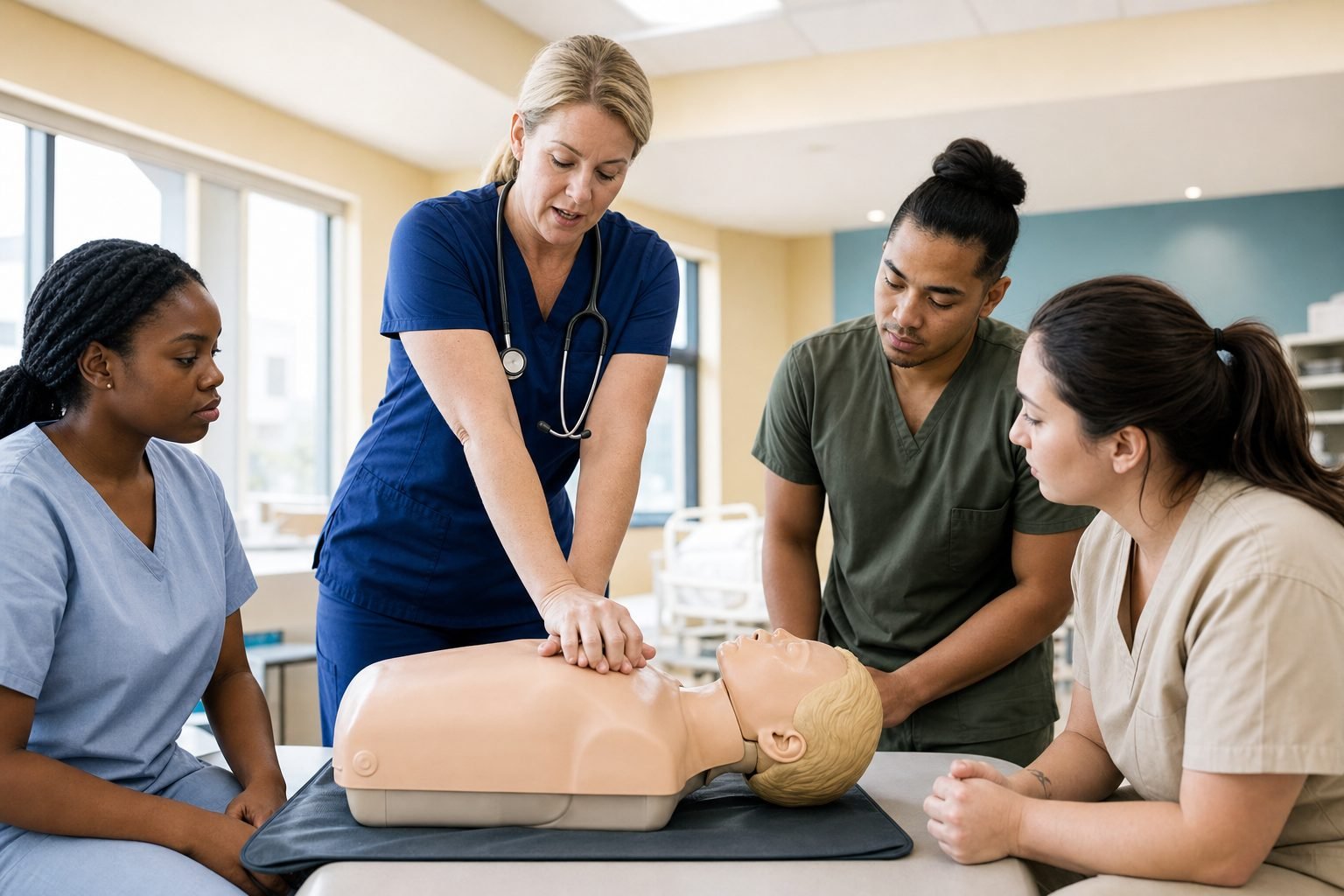
CPR / First Aid Certification — American Red Cross
4.0 hrsIn-personRN · ARC Instructor

Adult and pediatric CPR, AED operation, choking response, and standard first aid — delivered by an American Red Cross Instructor with individual skills sign-off.

1.14
Consumer-Specific Orientation — §303(b) Beneficiary Training
1.0 hr / consumerIn-personQDDP

CES §303(b) requires beneficiary-specific orientation before unsupervised contact. DSPs are walked through each consumer's PCSP, BPIP, health history, and communication system.

Level 2

AR-CDSP II — Arkansas Certified Direct Support Professional II

Month 12 · 7 modules · person-centered practice, documentation depth, and the first CPR renewal.

11.5 hrs
2.1
Person-Centered Practices & PCSP Implementation
2.0 hrsBlendedQDDP

Person-Centered Service Plans in practice — discovery process, MAPS/PATH, and how the DSP turns plan goals into Tuesday-afternoon decisions.

2.2
EVV Documentation & Daily Notes
1.0 hrLMSLMSW Director

Electronic Visit Verification — the 21st Century Cures Act requirement applied to CES Waiver. DSP documentation that survives audit.

2.3
Supportive Living Domains & Community Integration
1.5 hrsLMSQDDP

The eight HCBS Supportive Living Domains — what real integration looks like beyond a billable outing.

2.4
Health Monitoring & Communication with Clinical Team
1.5 hrsIn-personRN Instructor

SBAR communication, baseline-vs-change observation, and the consumer-specific clinical escalation chain.

2.5
Medication Awareness for DSPs (Advanced)
1.5 hrsIn-personRN Instructor

Advanced medication observation — common IDD-relevant drug classes (antipsychotics, anticonvulsants, GI), side effects, and interaction red flags.

2.6
Behavioral Support — BPIP Introduction & Implementation
2.0 hrsBlendedQDDP under LMSW oversight

From reading a BPIP (L1) to implementing one. Fidelity, data collection, and feedback loops with the QDDP.

2.7
CPR / First Aid Renewal — American Red Cross
2.0 hrsIn-personRN · ARC Instructor

Annual CPR / First Aid renewal — required of every active DSP and signed off individually by the RN instructor.

Level 3

AR-CDSP III — Arkansas Certified Direct Support Professional III

Month 18 · 6 modules · mentorship, advanced behavioral support, and CNA pathway preparation.

10.5 hrs
3.1
Mentorship & On-the-Job Training Skills
2.0 hrsBlendedLMSW Director

L3 DSPs become AcuityCare peer mentors — shadowing structure, feedback frameworks, and the AcuityCare 30-60-90 onboarding model.

3.2
Advanced Behavioral Support — BPIP Development
2.0 hrsIn-personQDDP under LMSW oversight

DSPs contribute to BPIP development with the QDDP — turning observation data into intervention strategies.

3.3
Health Coordination & Care Transitions
2.0 hrsIn-personRN Instructor

Hospital, ER, and post-acute transitions for IDD consumers — DSP role, advocate behaviors, and discharge documentation.

3.4
Quality, Compliance & Self-Audit
1.5 hrsLMSLMSW Director

The DSP audit lens — how to review your own documentation, EVV, and BPIP fidelity before a state surveyor does.

3.5
Introduction to the CNA & Health Support Specialist Pathway
1.0 hrLMSRN Instructor

A practical preview of L4 — what AR-CNHS asks of you, what it costs, what it pays, and how to know whether the clinical track is yours.

3.6
CPR / First Aid Renewal — American Red Cross
2.0 hrsIn-personRN · ARC Instructor

Annual CPR/First Aid renewal at the L3 milestone — same standard, same instructor.

Level 4

AR-CNHS — Certified CNA & AcuityCare Health Support Specialist

Month 24+ · 12 modules · Parts A–D. The stacked Arkansas CNA + AcuityCare HSS credential.

120 hrs

Part A — CNA Certification Pathway

4.1
CNA Foundations — Basic Nursing & Resident Care
16 hrsIn-personRN Instructor

Arkansas state CNA curriculum foundations — the role of the nurse aide, communication with the licensed nurse, and resident-centered care.

4.2
Safe Patient Handling, Body Mechanics & Transfers
8 hrsIn-personRN Instructor

Gait belts, mechanical lifts, two-person transfers, and the body mechanics that keep DSPs working for the next ten years.

4.3
Personal Care & ADL Skills
8 hrsIn-personRN Instructor

Bathing, dressing, grooming, oral care, and toileting — dignified ADL support for adults with complex needs.

4.3B
Vital Signs, Observation & Reporting
4 hrsIn-personRN Instructor

Temperature, pulse, respiration, blood pressure, and SpO₂ — accurate technique and what each reading triggers.

4.4
Nutrition, Hydration & Feeding Support
4 hrsIn-personRN Instructor

Special diets, thickened liquids, aspiration prevention at the table, and how to escalate intake concerns.

4.5
Skin Integrity & Pressure Injury Prevention
4 hrsIn-personRN Instructor

Pressure injury staging, repositioning schedules, skin assessment, and reporting standards for the licensed nurse.

Part B — Health Support Specialist Advanced Modules

4.6
Bowel, Bladder & Elimination Care
4 hrsIn-personRN Instructor

Continence support, catheter awareness (HSS scope), bowel programs, and the IDD-specific risk of constipation cascades.

4.7
Infection Control & Standard Precautions in Clinical Settings
4 hrsIn-personRN Instructor

Bloodborne pathogens, OSHA standards, isolation precautions, and outbreak response in a clinical-adjacent setting.

4.7B
CNA Supervised Clinical Hours (Arkansas State Requirement)
16 hrsIn-personRN Instructor

State-mandated supervised clinical hours required for CNA certification — completed in an approved AcuityCare placement under the RN.

Part C — Clinical Integration & Nurse Delegation

4.8
Nursing Care Plan Integration & Structured Health Monitoring
4 hrsIn-personRN Instructor

Reading and contributing to a Nursing Care Plan — how the HSS lives in the clinical record alongside the PCSP.

4.9
Seizure Response & Neurological Support (Advanced)
4 hrsIn-personRN Instructor

Advanced seizure response — typing, timing, post-ictal observation, status epilepticus, and the HSS role in rescue protocols.

4.11
Supervised HSS Fieldwork — 40 Hours
40 hrsIn-personRN Instructor

The capstone — 40 hours of supervised AcuityCare HSS fieldwork. Direct RN observation, skill sign-off, and graduation to autonomous HSS practice.

Part D — Delegation & Annual Renewal

4.10
Delegated Clinical Tasks Under the AR Nurse Practice Act
2 hrsIn-personRN Instructor

Arkansas-specific nurse delegation rules — what an RN may delegate to an HSS, written delegation documentation, and the five-rights checklist.

4.12
CPR / First Aid Renewal — American Red Cross
2 hrsIn-personRN · ARC Instructor

CPR/First Aid renewal at the AR-CNHS milestone — annual renewal continues for the life of the credential.

Try it

Read a syllabus. Then try a lesson.

Module 1.6 — Trauma-Informed Care — is published live as a demo lesson, exactly how a new DSP would see it on Day 1.
RN-led clinical training